


Advancing Pancreatic Cancer Care Through Patient-Centered Research Targeting Metabolic Vulnerabilities
November 17, 2025
UH Research & Education Institute
Jordan Winter, MD, is a nationally recognized pancreatic cancer surgeon-scientist and medical educator who leverages his vast clinical expertise and innovative research to pinpoint the molecular underpinnings of the disease and identify new therapeutic targets, and more effective treatment strategies.
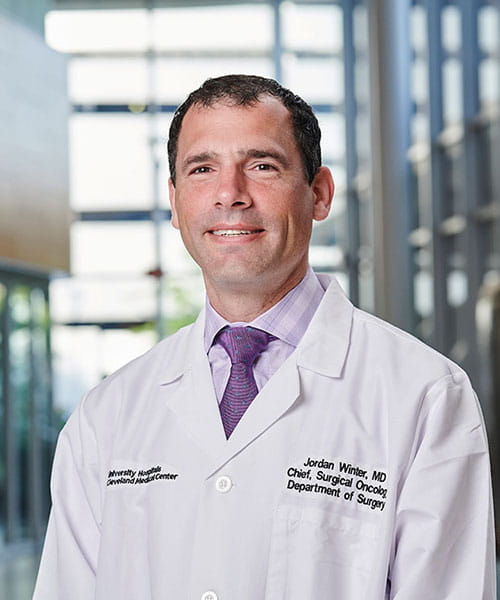 Jordan Winter, MD
Dr. Winter is the Director of Surgical Services at University Hospitals Seidman Cancer Center, Division Chief of Surgical Oncology and Co-director of the Developmental Therapeutics Program for the Case Comprehensive Cancer Center. As director of the Winter Lab, which is funded by the American Cancer Society, the Department of Defense and the National Institutes of Health, and supported by the UH Harrington Discovery Institute, Dr. Winter is at the forefront of investigational efforts to find alternative treatments for pancreatic cancer.
His research focuses on pancreatic cancer metabolism, the effect of glucose levels on chemotherapy effectiveness, and the identification of biomarkers for immunotherapy response. “Ultimately, we want to figure out all the biological signaling pathways that make pancreatic cancer cells grow, developing and administering new treatments, and preserving normal tissues in the process,” says Dr. Winter.
A rare combination of surgeon-scientist, Dr. Winter treats his patients like family members, embodying a deep commitment to helping them navigate a challenging cancer, while also mentoring colleagues and clinicians in training. His inquisitive, creative and perceptive approach to scientific investigations is fueled by dogged determination to crack the genetic and molecular codes that enable pancreatic cancer to adapt and thrive in harsh, nutrient and oxygen-deprived conditions.
At the Helm of Groundbreaking Pancreatic Research
As a leader in translational and basic research in pancreatic cancer, Dr. Winter says he is motivated to have as big an impact as he can as a clinician scientist, drawn, he says, to research that is important and innovative, yet understudied.
Most notably, Dr. Winter and his research team identified an important molecular target in pancreatic cancer, wild-type IDH1, a metabolic enzyme that enables cancer cells to adapt to the nutrient-deprived conditions in the tumor microenvironment. They likewise determined that a drug approved by the U.S. Food and Drug Administration to target mutant IDH1, ivosidenib, is also effective against the wild-type form of IDH1.
Furthermore, the researchers demonstrated that low magnesium levels assist in allosteric inhibition of wild-type IDH1, deadly to cancer cells in nutrient-deprived environments. Prior to this finding, ivosidenib was used exclusively against cancers with mutant IDHI1.
Identifying IDH1 as a promising and compelling therapeutic target provided a strong foundation for therapeutic development and more robust research that now includes studying complementary therapies that could make IDH1 inhibitors work better. These include using a ketogenic diet and PARP inhibitors, which help block cancer cells from repairing their DNA. Additionally, Dr. Winter and his team are also developing their own IDH1inhibitors, which have so far proven more effective than ivosidenib, the drug now being tested in clinical trials.
Integrating Science and Medicine to Advance Pancreatic Cancer Treatment
Dr. Winter was born and raised in northeast New Jersey. As a young adult, he set out to pursue a career in which he could combine his passion and curiosity for scientific investigations with opportunities to positively impact others in their greatest times of need.
He attended Princeton University and Weil Cornell Medical College. He completed his residency in general surgery at The Johns Hopkins Hospital before pursuing a Research Fellowship in Surgical Oncology, at the same hospital. He further honed his expertise at Memorial Sloan-Kettering Cancer Center in New York, where he completed a two-year fellowship in surgical oncology. Early in his career, as a trainee, he published extensively on the surgical management of pancreatic and related cancers.
After working at Thomas Jefferson University in Philadelphia, he arrived in Cleveland at University Hospitals to lead the Division of Surgical Oncology in 2018.
It was during his research fellowship at Johns Hopkins, working in the lab of Scott Kern, MD, a world-renowned pancreatic cancer geneticist, that Dr. Winter first became interested in research and questions around cancer metabolism, the mechanisms by which cancer cells grow and survive.
“I knew that if we could understand the metabolic pathways that are important in a cancer cell and how they differ from normal tissues, then maybe we could target them” to arrest cancer cells, recalls Dr. Winter. “So, I became very excited about metabolism and started studying it.”
In 2011, he joined the lab of his best friend and mentor, Jonathan Brody, PhD, another prominent pancreatic cancer researcher. Dr. Brody was studying HuR, an RNA-binding protein that promotes tumor growth, metastasis, and drug resistance in pancreatic cancer. In studying how HuR regulates cancer metabolism, the researchers determined that HuR regulates IDH1, a critical research development.
It is HuR's regulation of IDH1 that enables cancer cells in the pancreas to survive and resist chemotherapy by upregulating IDH1 expression under nutrient-deprived or low-glucose conditions.
An Unwavering Commitment to Patients and Improved Pancreatic Cancer Outcomes
Pancreatic cancer is notoriously complex and difficult to treat, but throughout his career, Dr. Winter has remained steadfast in his efforts to advance research and medicine in a field where patients typically face difficult odds, unafraid to take calculated risks, leaving nothing to chance. As he sees it, that focus and perseverance is required for successful research.
“What research means to you is so important, and what you can get from it really has to drive you,” says Dr. Winter. “If it’s not something that propels you day in and day out, from a mission-driven standpoint, there is not chance that you can be successful.”
Dr. Winter tells trainees and colleagues that being a clinician-scientist requires resilience, to get up when you fail. Likewise, teamwork is an absolute must. “This isn’t singles tennis, this is an 11-person soccer team,” he says. “You’re only as good as your weakest link.” Equally important is the ability to accept tough feedback, from friends, mentors and colleagues, especially when it comes to grant proposals.
From experience, Dr. Winter has come to expect that applying for a grant is a two-and-a-half-to-three-year process. “I almost look forward to that first rejection, because it gets me closer to the finish line as I learn to make things better,” he quips.
Dr. Winter is inspired by his patients and hopeful that his clinical and scientific contributions will advance pancreatic cancer treatment, providing patients with more options. “I have found that taking care of patients with cancer has been far more rewarding than I ever could have imagined,” says Dr. Winter. “Forming personal connections with patients and their families during their cancer journey is one of the greatest privileges and aspects of my job.”
In addition to pancreatic cancer, he also treats patients with upper gastrointestinal malignancies and abdominal tumors. He has authored more than 100 peer-reviewed articles and a dozen book chapters, many of them on pancreatic cancer.
When he is not in his lab, in an operating room or at a patient’s bedside, Dr. Winter enjoys running and spending time with his family.